Have you ever paused to truly grasp what something means? 🤔
Whether it’s a concept, a skill, or even a word, understanding its full depth can be life-changing.
Today, we’re diving deep into the grasp meaning, exploring its origins, practical applications, and how mastering it can elevate your personal and professional life.
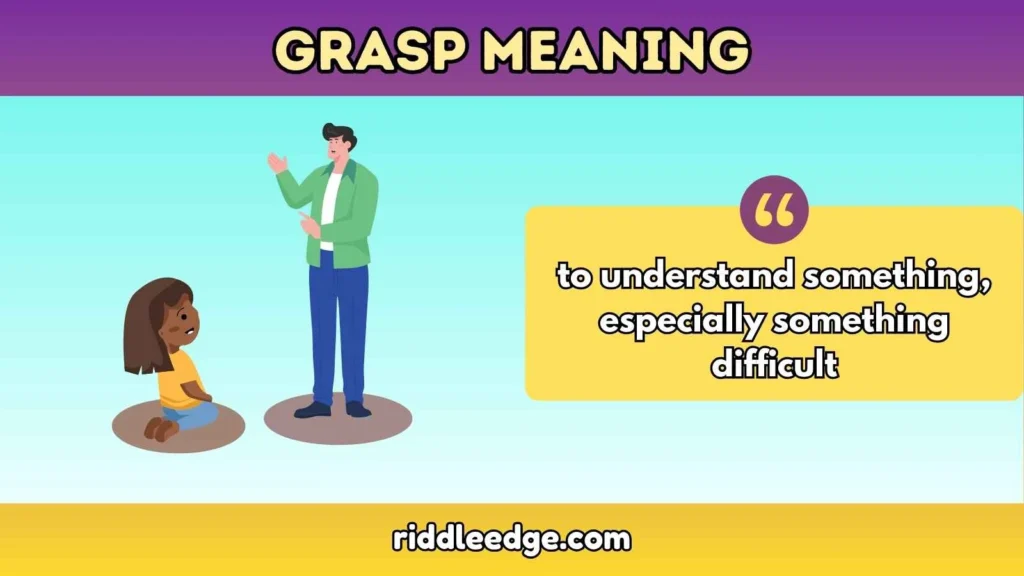
What Does “Grasp” Mean? 📖
The word grasp has both literal and figurative meanings:
- Literal: To seize or hold something firmly with your hand. ✋
- Figurative: To understand or comprehend an idea, concept, or situation fully. 💡
Example: “She finally grasped the complex math problem after hours of study.”
Origin of the Word “Grasp” 🏛️
The term grasp originates from the Old English word græpsan, meaning “to seize” or “to snatch.” Over centuries, it evolved to include intellectual comprehension, emphasizing both physical and mental holding power. 📚
Why Grasping Matters in Daily Life 🌱
Understanding the grasp meaning isn’t just academic—it’s practical. Strong comprehension skills:
- Boost problem-solving abilities 🧩
- Enhance learning efficiency 📘
- Improve communication clarity 🗣️
Grasp vs. Understand: What’s the Difference? 🤓
While grasp and understand are similar, there’s a subtle difference:
- Grasp: Implies quick, firm comprehension, often intuitive. ⚡
- Understand: Suggests deeper, more reflective comprehension. 🧠
Types of Grasp in Learning and Life 📚
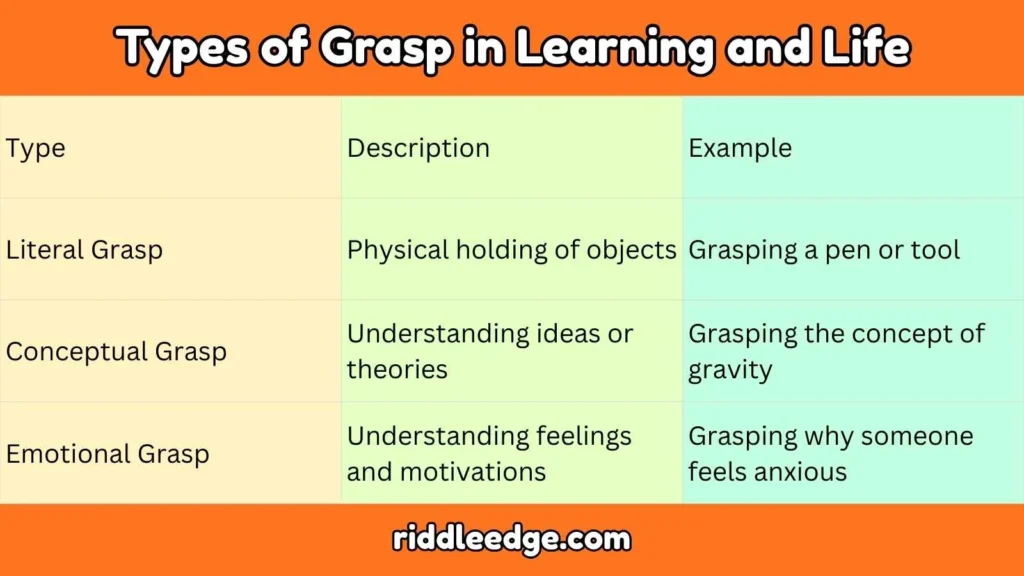
Not all grasps are equal. Here are the main types:
| Type | Description | Example |
|---|---|---|
| Literal Grasp | Physical holding of objects | Grasping a pen or tool |
| Conceptual Grasp | Understanding ideas or theories | Grasping the concept of gravity |
| Emotional Grasp | Understanding feelings and motivations | Grasping why someone feels anxious |
How to Improve Your Ability to Grasp Concepts 💪
Mastering comprehension is a skill. Here’s how:
- Focus your attention fully on the topic 🧘
- Break information into small, digestible parts 📝
- Use visual aids like diagrams and charts 📊
- Teach others what you’ve learned 👩🏫
- Review and reflect regularly 🔄
Examples of Grasp in Sentences ✍️
Here are varied examples to showcase usage:
- Literal: “He grasped the rope tightly to climb.”
- Figurative: “She couldn’t fully grasp the concept of time travel.”
- Emotional: “I can’t grasp why she is upset.”
Grasp in Education and Skill Development 🎓
Students and professionals alike benefit from improving grasp:
- Accelerates learning of new subjects 📚
- Enhances mastery of complex skills 🛠️
- Boosts confidence in problem-solving 🏆
Common Mistakes When Trying to Grasp Something ❌
Even experienced learners stumble. Avoid these:
- Rushing without focus ⏩
- Overloading on information 🧠💥
- Ignoring context and examples 📝
- Failing to revisit the material 🔄
Practical Tools to Enhance Grasping Skills 🛠️
From mind maps to spaced repetition, tools can make a huge difference:
- Flashcards for memory retention 🃏
- Mind-mapping apps for visual learning 🗺️
- Interactive exercises and quizzes 🧩
- Discussion groups and forums 💬
Grasp in Communication and Relationships 💬
Grasping isn’t just intellectual; it strengthens personal connections:
- Understanding others’ perspectives 👥
- Enhancing empathy and emotional intelligence ❤️
- Reducing misunderstandings in conversations 🗣️
Quotes About Grasping Knowledge and Life 🌟
“Real knowledge is to know the extent of one’s ignorance.” – Socrates
“To grasp the world in a grain of sand requires focus and insight.”
Advanced Techniques for Deep Grasp 🧠
For thinkers and professionals aiming for mastery:
- Practice deliberate learning with purpose 🎯
- Apply concepts in real-life situations 🔧
- Reflect through journaling or discussion 📝
- Connect new knowledge with existing frameworks 🔗
Common Phrases and Idioms Using “Grasp” 🗣️
- Grasp at straws: Trying anything in desperation 🌾
- Firm grasp: Strong understanding of a topic ✊
- Slip through one’s grasp: Miss an opportunity 😔
FAQs
- Q: What is the literal meaning of grasp?
- A: To physically hold or seize something firmly. ✋
- Q: What is the figurative meaning of grasp?
- A: To fully understand or comprehend a concept, idea, or situation. 💡
- Q: How can I improve my grasp of complex topics?
- A: Focus, break concepts into smaller parts, use examples, teach others, and review regularly. 📘
- Q: Is grasp different from understand?
- A: Yes, grasp often implies quicker, intuitive comprehension, while understand suggests deeper, reflective insight. 🧠
Conclusion:
Understanding the grasp meaning goes beyond words—it’s about truly holding ideas, concepts, and even emotions.
By practicing focus, applying knowledge, and using the tools we discussed, anyone can improve their grasp and make learning more effective, meaningful, and enjoyable. 🌟

I love exploring the meaning behind words and ideas, turning simple thoughts into clear and engaging content. At Punswave, I focus on explaining meanings in an easy and interesting way for everyone.