Have you ever heard someone speak in a way that motivated your heart, strengthened your resolve, or pushed you to do better—not through pressure, but through uplifting words? 😊 That powerful act is called exhortation.
Understanding the exhortation meaning is more than learning a dictionary definition. It is about recognizing how words can encourage action, inspire growth, and guide people toward positive change. From everyday conversations to religious sermons, leadership speeches, and personal advice, exhortation plays a vital role in human communication.
In this in-depth guide, you will explore the meaning of exhortation, its origin, usage, examples, emotional impact, and practical applications—explained in a clear, friendly, and expert way. 🌱
What Is the Meaning of Exhortation?
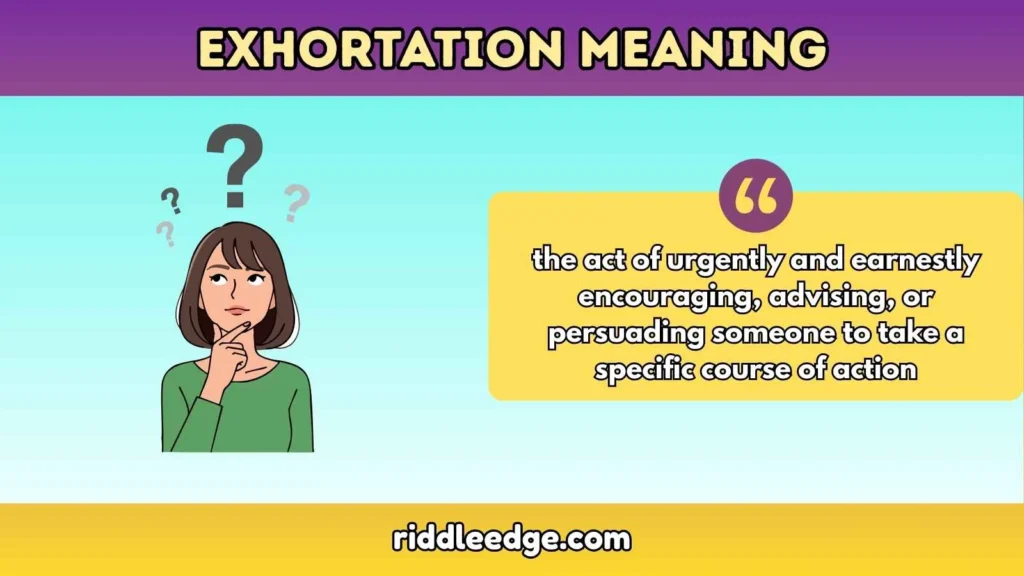
The exhortation meaning refers to strong encouragement or advice given to motivate someone toward a positive or moral action. It involves urging someone to act in a certain way—often with sincerity, care, and purpose.
Unlike commands or demands, exhortation focuses on inspiration rather than force. It appeals to emotions, values, and conscience.
In simple words:
- Exhortation means encouraging someone to do better
- It is advice given with moral or emotional support
- It aims to uplift, guide, or motivate
Exhortation Meaning in Simple English

In simple English, exhortation means speaking to someone in a way that encourages them to act positively.
For example:
“The coach’s exhortation inspired the team to give their best effort.”
Here, the coach did not threaten or force the players. Instead, the words motivated and energized them. 💪
Origin and History of the Word Exhortation
To truly understand the exhortation meaning, it helps to explore its roots.
The word exhortation comes from the Latin term “exhortari”, which means:
- “ex-” → out
- “hortari” → to urge or encourage
Together, they express the idea of urging someone forward. This historical meaning aligns perfectly with how exhortation is used today.
Ancient philosophers such as :contentReference[oaicite:0]{index=0} emphasized persuasive speech that appealed to character and emotion—ideas closely connected to exhortation.
Grammatical Use of Exhortation
The word exhortation functions as a noun.
Related word forms include:
- Exhort (verb) – to strongly encourage
- Exhorting (present participle)
- Exhorted (past tense)
Example:
“She exhorted her children to remain honest and kind.”
Exhortation vs Advice vs Command
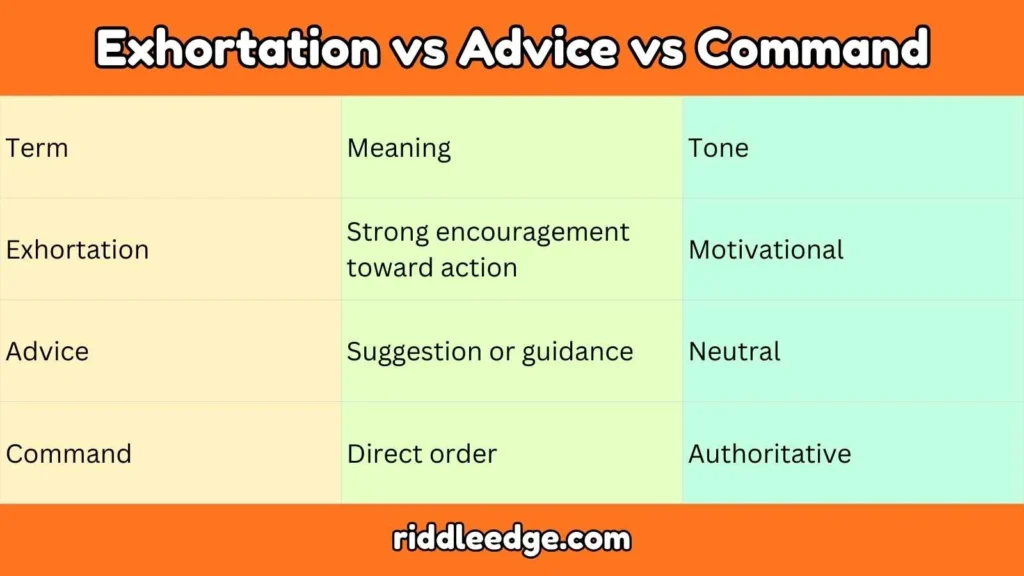
| Term | Meaning | Tone |
|---|---|---|
| Exhortation | Strong encouragement toward action | Motivational |
| Advice | Suggestion or guidance | Neutral |
| Command | Direct order | Authoritative |
The key difference is that exhortation motivates from within, while commands enforce obedience.
The Emotional Power of Exhortation
Exhortation is powerful because it connects emotionally. ❤️ It speaks to:
- Hope
- Responsibility
- Self-belief
- Moral values
A well-delivered exhortation can change behavior, strengthen faith, and inspire courage.
Exhortation Meaning in Religious Contexts
In religious settings, exhortation often appears in sermons, teachings, and moral guidance.
In the :contentReference[oaicite:1]{index=1}, exhortation refers to encouraging believers to live righteously, remain faithful, and help one another.
Example:
“The preacher’s exhortation reminded the congregation to practice compassion and patience.”
Exhortation Meaning in Everyday Life
You encounter exhortation more often than you realize. 🌍
- A parent encouraging a child to study
- A teacher motivating students
- A friend urging you not to give up
All of these are examples of exhortation in action.
Exhortation in Leadership and the Workplace

Effective leaders use exhortation to inspire teams rather than control them.
Example:
“The manager’s exhortation boosted team morale during challenging times.”
This approach builds trust and long-term commitment.
Exhortation in Literature and Writing
Authors often use exhortation to persuade readers toward a moral lesson or action.
Speeches, essays, and motivational writing rely heavily on exhortation to create impact.
Real-Life Examples of Exhortation
- “I exhort you to stay true to your values.”
- “She offered words of exhortation to encourage honesty.”
- “The speech ended with a strong exhortation for unity.”
How to Use Exhortation Effectively
To use exhortation well:
- Be sincere
- Appeal to values
- Encourage, don’t threaten
- Speak with empathy
Common Mistakes When Using Exhortation
Avoid turning exhortation into:
- Harsh criticism
- Emotional pressure
- Repeated nagging
True exhortation should feel uplifting, not exhausting.
FAQs
Is exhortation always positive?
Yes, exhortation is intended to encourage positive action, even when addressing difficult topics.
Can exhortation be written?
Absolutely. Exhortation appears in speeches, letters, books, and motivational writing.
Is exhortation the same as persuasion?
They are related, but exhortation focuses more on moral encouragement than logical argument.
Can anyone give exhortation?
Yes. Anyone can exhort others through sincere and thoughtful words.
Final Thoughts
Understanding the exhortation meaning helps you appreciate the power of words to inspire change.
Whether used in leadership, faith, education, or personal relationships, exhortation remains a timeless and effective way to guide others with compassion and purpose. 🌟
When spoken with sincerity, exhortation can strengthen hearts, uplift minds, and encourage people to become their best selves.

I love exploring the meaning behind words and ideas, turning simple thoughts into clear and engaging content. At Punswave, I focus on explaining meanings in an easy and interesting way for everyone.