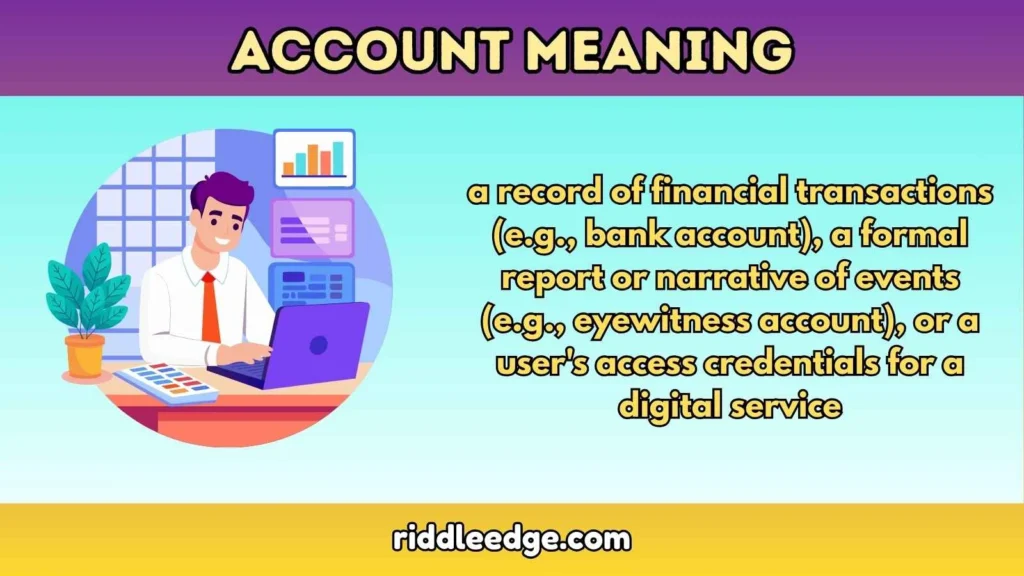
Have you ever wondered what the term “account” really means? 🤔 From social media to banking, the word account appears everywhere.
Understanding its meaning is essential not just for professionals but for everyone navigating the modern world.
In this guide, we’ll break down account meaning, types, examples, and practical insights you can use every day. 🌟
What Does “Account” Mean? 📝
The term account generally refers to a record or statement of financial transactions, or more broadly, a representation of an identity in various systems. It comes from the Old French word aconter, meaning “to reckon or count.” Essentially, an account is a way to track, manage, and record information. 📊
Key Aspects of an Account
- Record Keeping: Tracks transactions or activities.
- Identity: Represents a user or entity in a system.
- Access: Usually secured with credentials like usernames and passwords.
- Balance: Can show financial or informational status.
Types of Accounts 🌐
Accounts are everywhere, but they mainly fall into three broad categories: financial, online, and business accounts. Let’s explore each one. 💼
1. Financial Accounts 💰

Financial accounts are the most common type. They track money, assets, and liabilities. Examples include:
- Bank Account: Savings, checking, and current accounts.
- Investment Account: Stocks, bonds, or mutual funds.
- Credit Account: Credit cards and loans.
| Type | Description | Example |
|---|---|---|
| Savings Account | A secure place to store money and earn interest | Bank of America Savings |
| Checking Account | Used for daily transactions and bill payments | Chase Checking Account |
| Credit Account | Allows borrowing with repayment terms | Visa Credit Card |
2. Online Accounts 🌐
Online accounts allow you to access digital services, social media, or apps. Examples include:
- Email Account: Gmail, Outlook
- Social Media Account: Facebook, Instagram, Twitter
- Gaming Account: PlayStation Network, Steam
3. Business Accounts 🏢
Businesses also maintain accounts to track operations, revenue, and client relationships.
- Customer Account: Records customer interactions and purchases
- Supplier Account: Tracks supplier transactions and payments
- Employee Account: HR systems or payroll tracking
Origin and History of Accounts ⏳
The concept of accounts dates back to ancient civilizations. Merchants in Mesopotamia and Egypt used basic ledgers to track trade and inventory. The modern double-entry accounting system was formalized in the 15th century by Luca Pacioli, often called the “Father of Accounting.” 🏛️
Why Understanding Accounts Is Important 🎯
Understanding accounts is crucial for financial literacy, professional development, and digital safety. Some key reasons include:
- Financial Planning: Helps manage expenses and savings.
- Transparency: Tracks transactions for businesses and personal use.
- Security: Ensures online identities are protected.
- Decision Making: Helps in making informed choices with data.
How Accounts Work: The Mechanics ⚙️
Accounts work as a system of records. They can be simple or complex depending on the type. Financial accounts involve debits and credits, while online accounts involve authentication and data tracking. 🖥️
Financial Account Mechanics
- Debits: Money going in
- Credits: Money going out
- Balance: Difference between debits and credits
Online Account Mechanics
- Username & Password: Basic login credentials
- Two-Factor Authentication (2FA): Extra security layer
- Data Storage: Tracks activity, preferences, and history
Examples of Accounts in Daily Life 🌟
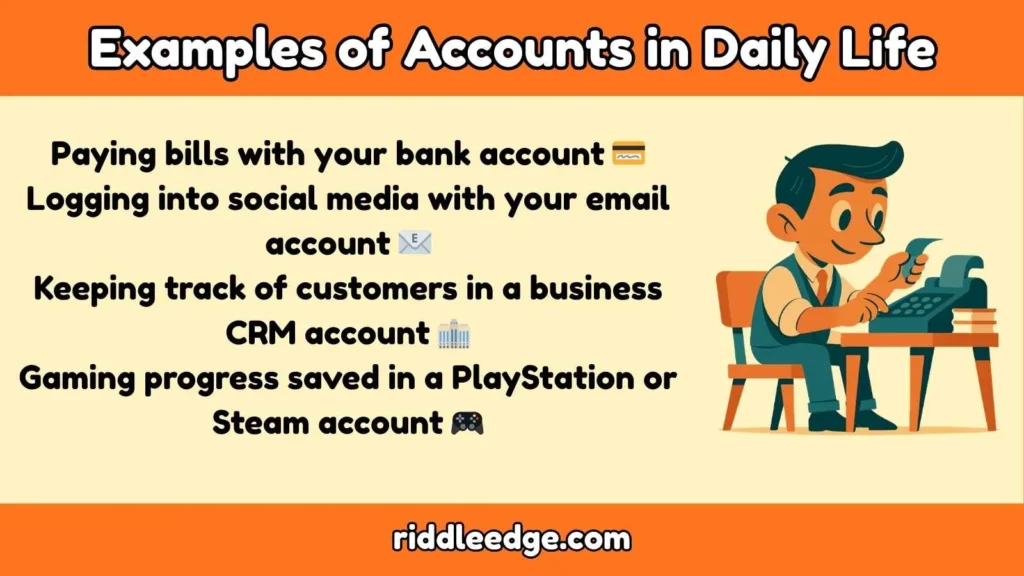
Accounts are everywhere, not just in banks. Here are some practical examples:
- Paying bills with your bank account 💳
- Logging into social media with your email account 📧
- Keeping track of customers in a business CRM account 🏢
- Gaming progress saved in a PlayStation or Steam account 🎮
Account vs. Profile: Understanding the Difference 🤔
People often confuse account and profile. Here’s a simple distinction:
- Account: Authentication & access to a system.
- Profile: Personal details, settings, and preferences within an account.
Managing Accounts Effectively ✅
Effective account management improves security and organization. Here are some tips:
- Use strong, unique passwords 🔑
- Enable 2FA whenever possible 🔒
- Regularly review account activity 👀
- Organize financial accounts using apps or spreadsheets 📊
Common Terms Related to Accounts 📚
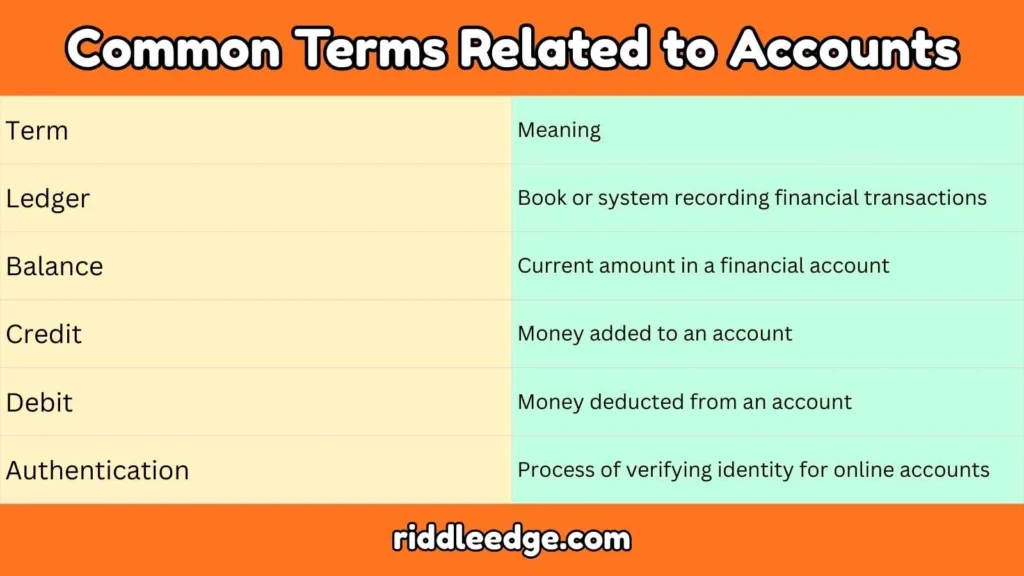
| Term | Meaning |
|---|---|
| Ledger | Book or system recording financial transactions |
| Balance | Current amount in a financial account |
| Credit | Money added to an account |
| Debit | Money deducted from an account |
| Authentication | Process of verifying identity for online accounts |
Benefits of Understanding Accounts 🌟
- Financial Literacy: Know where your money goes 💵
- Security: Protect personal and sensitive data 🔐
- Efficiency: Manage multiple accounts without confusion 🗂️
- Business Growth: Track revenue, expenses, and client data 📈
Common Mistakes People Make with Accounts ⚠️
- Using the same password across multiple accounts ❌
- Ignoring account activity alerts ❌
- Mixing personal and business accounts ❌
- Failing to track financial statements ❌
Future of Accounts: Trends to Watch 🚀
With technology evolving, accounts are becoming smarter and more secure. Trends include:
- Biometric authentication (fingerprint, face ID) 👆
- Blockchain-based accounts for secure transactions 🔗
- AI-powered account management for personalized insights 🤖
Real-Life Example: Financial Account Tracking 💵
Imagine Jane has a savings account of $5,000. She deposits $1,000 and pays a $500 bill. Her account balance is updated automatically:
- Initial balance: $5,000
- Deposit: +$1,000
- Payment: -$500
- Current balance: $5,500 ✅
Practical Tips for Online Account Safety 🛡️
- Never share passwords with anyone 🔑
- Use a password manager to store complex passwords 🧠
- Regularly update security questions and backup emails 💌
- Monitor account activity for unusual behavior 👀
FAQs
1. What is the primary meaning of account?
An account is a record of financial transactions or a representation of a user’s identity in a system.
2. How many types of accounts exist?
Primarily three types: financial, online, and business accounts. Each has specific uses and features.
3. Why is account management important?
It ensures security, transparency, and efficiency in both financial and digital systems.
4. Can one person have multiple accounts?
Yes, individuals often have multiple bank accounts, social media accounts, and business accounts.
5. What’s the difference between an account and a profile?
An account grants access, while a profile contains personal details and settings within that account.
Conclusion:
Understanding the account meaning is essential in today’s digital and financial world.
Whether it’s managing finances, social media, or business data, accounts help you track, control, and secure your information.
By following best practices and staying informed, you can make the most out of your accounts and avoid common pitfalls. ✅

I love exploring the meaning behind words and ideas, turning simple thoughts into clear and engaging content. At Punswave, I focus on explaining meanings in an easy and interesting way for everyone.