Sequester meaning is a term many people see in news headlines, legal documents, academic texts, or even casual conversations—but few truly understand it with confidence. 🤔 If you have ever paused while reading an article or listening to the news and wondered, “What does sequester really mean?”, you are not alone.
This in-depth guide explains the sequester meaning in plain, human language. We’ll explore its origin, modern usage, legal and economic contexts, real-life examples, and common misunderstandings—all in a friendly, expert tone that’s easy to follow. ✅
By the end of this article, you will not only know the meaning of sequester, but you’ll also know when, why, and how to use it correctly.
What Is the Sequester Meaning? (Simple Definition) ✍️
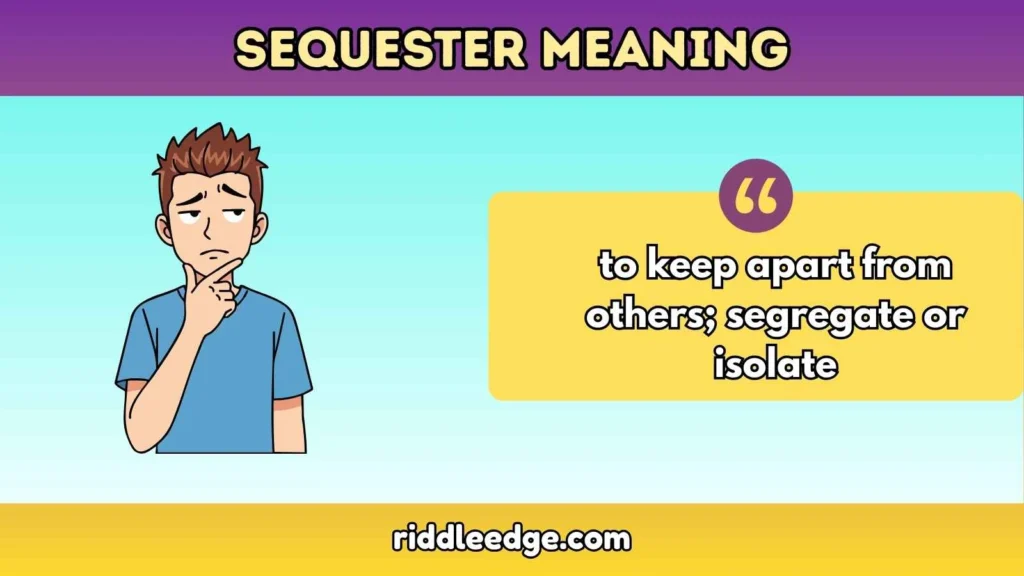
At its core, the sequester meaning refers to the act of separating, isolating, or setting something aside from others.
To sequester means:
- To isolate or remove something from general use
- To place apart for protection, control, or decision-making
- To temporarily or permanently restrict access
In everyday terms, sequestering is about keeping something separate for a specific purpose. That purpose depends on context—law, economics, environment, or general usage.
Origin and History of the Word Sequester 🕰️
Understanding the sequester meaning becomes easier when we look at its roots.
The word sequester comes from the Latin word “sequestrare”, which means “to hand over to a trustee” or “to set aside”.
Historically, the term was used in:
- Roman law to describe property held by a neutral third party
- Medieval legal systems to isolate disputed assets
- Religious and academic contexts to describe retreat or isolation
Over time, the meaning expanded but retained its central idea: controlled separation.
Sequester Meaning in Everyday Language 🗣️
In casual conversation, the sequester meaning often implies intentional isolation.
Examples:
- “The manager decided to sequester the faulty products.”
- “She sequestered herself from social media to focus on exams.”
- “Important documents were sequestered for review.”
In these cases, sequester does not sound harsh—it simply means keeping something apart for a reason.
Sequester Meaning in Law ⚖️
One of the most common formal uses of the term appears in legal contexts.
In law, the sequester meaning usually refers to:
- Removing assets from control during a legal dispute
- Isolating a jury to prevent external influence
- Holding property under court authority
Example:
The court ordered the jury to be sequestered to ensure an unbiased verdict.
Here, sequestering protects the integrity of the legal process.
Sequester Meaning in Economics and Government 💰
The sequester meaning gained widespread attention in economic discussions, especially in government budgeting.
In this context, sequester refers to:
Automatic spending cuts imposed to control government deficits.
These cuts:
- Apply across multiple departments
- Are enforced when budget agreements fail
- Affect defense, education, healthcare, and more
Economic sequestration is often controversial because it applies broad restrictions without prioritizing individual programs.
Sequester Meaning in Environmental Science 🌱
In environmental studies, the sequester meaning takes on a positive and protective tone.
It refers to the process of capturing and storing substances, especially carbon.
Common examples include:
- Carbon being sequestered in forests 🌳
- Soil sequestering organic matter
- Oceans sequestering atmospheric carbon dioxide
Environmental sequestration helps reduce climate impact and maintain ecological balance.
Sequester vs Similar Words 🔍
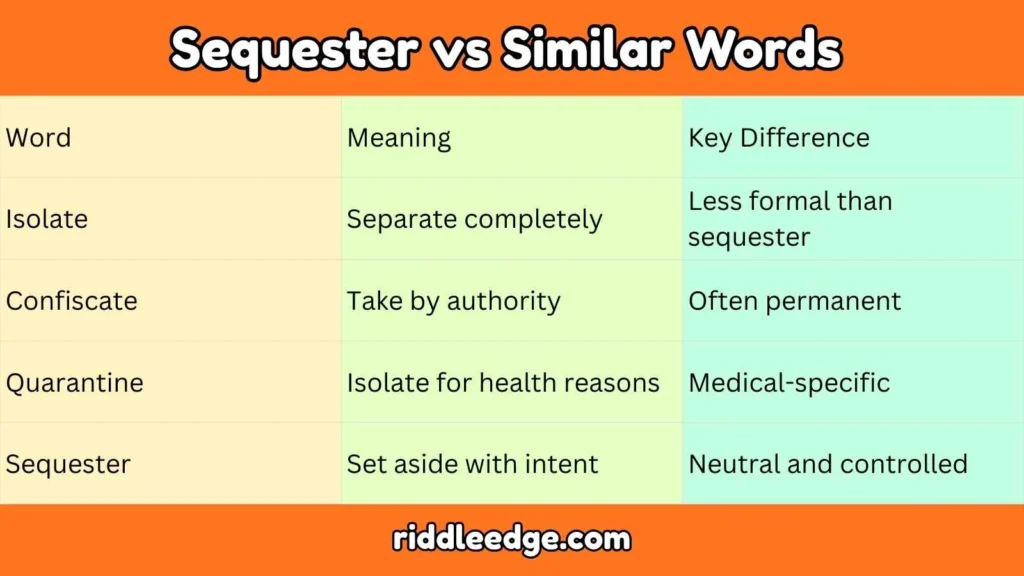
To fully grasp the sequester meaning, it helps to compare it with similar terms.
| Word | Meaning | Key Difference |
|---|---|---|
| Isolate | Separate completely | Less formal than sequester |
| Confiscate | Take by authority | Often permanent |
| Quarantine | Isolate for health reasons | Medical-specific |
| Sequester | Set aside with intent | Neutral and controlled |
This comparison shows why sequester is often chosen in formal or technical writing.
Positive and Negative Connotations of Sequester ⚖️
The sequester meaning can feel positive or negative depending on usage.
Positive contexts:
- Protecting evidence
- Reducing environmental harm
- Ensuring fairness
Negative contexts:
- Budget cuts affecting services
- Forced isolation
- Loss of access
The word itself is neutral—context gives it emotion.
How to Use Sequester in a Sentence ✨
Using the word correctly shows strong vocabulary skills.
Examples:
- The committee sequestered the data for further analysis.
- Funds were sequestered until the audit was complete.
- The judge sequestered the witnesses.
Notice how the word implies intentional and controlled separation.
Common Mistakes When Using Sequester ❌
Many people misuse the term due to confusion.
Avoid these mistakes:
- Using it as a synonym for “hide”
- Using it casually in informal chat
- Applying it without a clear purpose
Remember: the sequester meaning always involves reasoned separation.
Why Sequester Is a Powerful Word in Writing ✍️
The word sequester adds clarity and authority.
It is often used in:
- Academic writing
- Legal documents
- Policy discussions
- Environmental reports
Its precision makes it ideal for expert communication.
FAQs
What is the simplest sequester meaning?
It means to set something apart or isolate it for a specific purpose.
Is sequester always negative?
No. The sequester meaning is neutral and depends on context.
Is sequester used in daily conversation?
Rarely. It’s more common in formal, academic, or professional settings.
Can people be sequestered?
Yes, especially in legal or professional contexts.
What’s the difference between isolate and sequester?
Sequester implies intentional and controlled separation.
Final Thoughts:
The sequester meaning goes far beyond a simple definition. It represents a powerful concept of intentional separation for protection, fairness, or control.
Whether used in law, economics, environmental science, or formal writing, understanding this word helps you read, write, and communicate with greater confidence. 💡
Mastering words like sequester sharpens your language skills and strengthens your authority.

I love exploring the meaning behind words and ideas, turning simple thoughts into clear and engaging content. At Punswave, I focus on explaining meanings in an easy and interesting way for everyone.