Battery charge meaning is one of those everyday concepts we all rely on but rarely stop to fully understand. From checking your phone’s battery percentage 📱 to monitoring an electric vehicle’s charge 🚗, battery charge quietly controls how long your devices last, how efficiently they perform, and even how safe they are to use.
If you have ever wondered why your phone drops from 20% to 0% so fast, or what “fully charged” actually means in technical terms, you are not alone. This guide explains the battery charge meaning in clear, human language—without jargon, confusion, or fluff.
By the end of this article, you will understand how battery charge works, how to read it accurately, and how to protect your batteries for long-term performance ⚡.
What Is Battery Charge Meaning? 🤔
The battery charge meaning refers to the amount of electrical energy stored inside a battery at a given time. It tells you how much usable power remains before the battery needs recharging.
In simple terms:
- 100% charge means the battery is full
- 50% charge means half of the stored energy is available
- 0% charge means the battery is empty and cannot power a device
Battery charge is commonly shown as a percentage, bars, or color indicators. While the display looks simple, the science behind it is surprisingly complex.
Why Battery Charge Is So Important 🔌
Understanding the battery charge meaning is essential because it affects:
- Device performance – Low charge can slow down electronics
- Battery lifespan – Poor charging habits shorten battery life
- Safety – Overcharging or deep discharging can cause damage
- Productivity – Knowing charge levels prevents sudden shutdowns
Whether you use a smartphone, laptop, power bank, or electric scooter, battery charge awareness helps you stay in control.
The Basic Science Behind Battery Charge ⚙️
At its core, battery charge is stored chemical energy. Inside a battery, chemical reactions create a flow of electrons. This flow becomes electrical power when connected to a device.
When a battery is:
- Charging – Energy is stored through chemical reactions
- Discharging – Stored energy is released to power a device
The battery charge meaning describes how much of this stored chemical energy remains available.
Think of a battery like a water tank. Charging fills the tank. Using a device drains it.
Battery Charge vs Battery Capacity 🔋
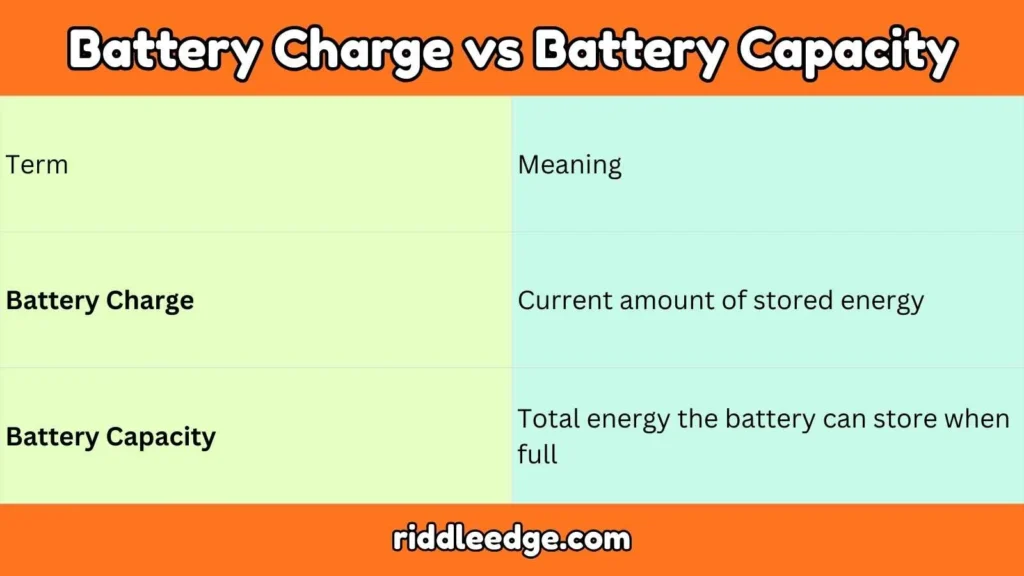
Many people confuse battery charge with battery capacity, but they are not the same.
| Term | Meaning |
|---|---|
| Battery Charge | Current amount of stored energy |
| Battery Capacity | Total energy the battery can store when full |
A battery can show 100% charge but still have low capacity due to aging. That is why older devices drain faster even when fully charged.
How Battery Charge Is Measured 📊
The battery charge meaning is calculated using voltage, current, and time. Most modern batteries use a system called state of charge.
Common measurement methods include:
- Voltage-based estimation
- Coulomb counting
- Smart battery management systems
These systems estimate how much energy remains and convert it into the percentage you see on your screen.
What Does Battery Percentage Really Mean? 🔢
Battery percentage is an estimate, not an exact number. When your device says 20%, it means approximately 20% of usable energy remains under current conditions.
This explains why:
- Battery drains faster during heavy use
- Cold temperatures reduce battery performance
- Older batteries behave unpredictably
The battery charge meaning changes dynamically based on how the battery is used.
Charging Stages and Their Meaning ⚡
Charging is not a single process. It happens in stages:
- Fast charge stage – Rapid energy intake
- Absorption stage – Slower charging to protect the battery
- Trickle charge – Maintains full charge safely
This staged approach explains why charging slows down near 100%.
Battery Charge Meaning in Everyday Devices 📱💻
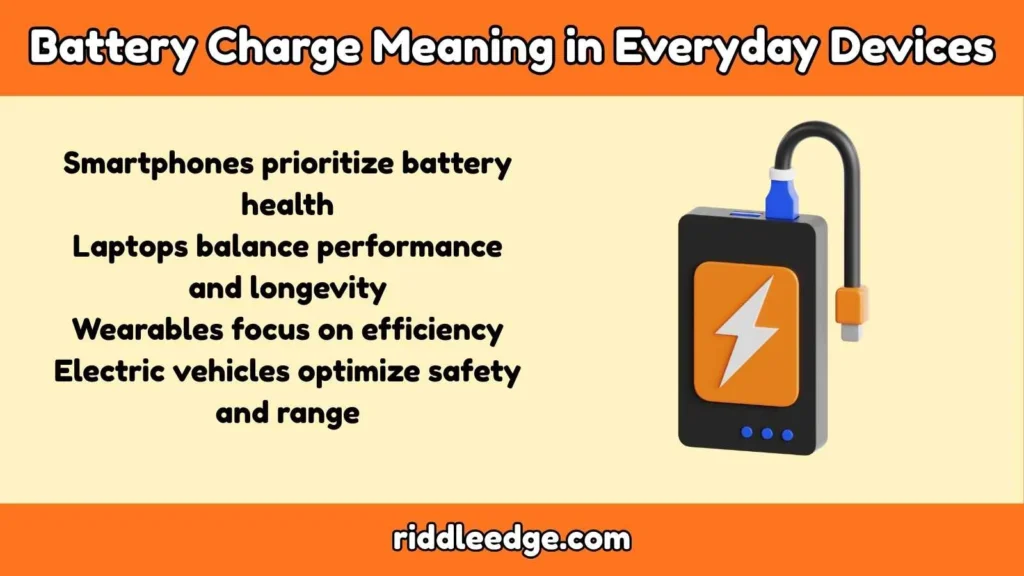
Different devices interpret battery charge differently:
- Smartphones prioritize battery health
- Laptops balance performance and longevity
- Wearables focus on efficiency
- Electric vehicles optimize safety and range
Understanding the battery charge meaning helps you adjust usage habits for each device.
Low Battery Warnings Explained 🚨
Low battery alerts are designed to protect your device. When charge drops below certain levels, systems reduce performance to conserve energy.
Typical warning levels include:
- 20% – Early warning
- 10% – Power-saving mode
- 5% – Critical shutdown risk
These warnings are based on estimated remaining battery charge.
Does 100% Battery Mean Fully Charged? ❓
Surprisingly, not always. Many devices stop charging slightly below true maximum capacity to protect battery health.
This means:
- 100% shown ≠ absolute maximum
- Built-in buffers prevent damage
The battery charge meaning displayed is optimized for safety, not raw capacity.
Common Myths About Battery Charge ❌
Let’s clear up some popular misconceptions:
- Myth: You must drain batteries to 0%
- Fact: Partial charging is healthier
- Myth: Overcharging ruins batteries instantly
- Fact: Modern devices prevent overcharging
Understanding the real battery charge meaning helps you avoid harmful habits.
How Battery Charge Affects Battery Life 🕒
Battery life is directly influenced by how charge levels are managed. Repeated deep discharges and constant full charges increase wear.
Best practices include:
- Keep charge between 20% and 80%
- Avoid extreme temperatures
- Use certified chargers
These habits preserve long-term battery health.
Battery Charge Meaning in Power Banks and Backup Systems 🔋
For power banks, battery charge indicates stored backup energy. Higher capacity means more recharge cycles for your devices.
Always check:
- Input and output ratings
- Charge indicators accuracy
- Safety certifications
Origin of the Term “Battery Charge” 📜
The concept of battery charge comes from early electrical research where stored electric energy was referred to as “charge.” Over time, the term evolved to describe energy stored chemically in batteries.
Today, the battery charge meaning combines physics, chemistry, and smart software.
Practical Examples of Battery Charge Meaning 💡
- A phone at 30% may last hours in standby
- A laptop at 30% may last minutes under heavy load
- An electric bike at 30% has reduced range
Context matters when interpreting battery charge.
FAQs
What is the simplest battery charge meaning?
It means how much power is left inside a battery.
Is battery percentage always accurate?
No. It is an estimate based on usage and conditions.
Why does battery drain faster at low charge?
Voltage drops and efficiency decreases as charge lowers.
Can battery charge affect performance?
Yes. Devices often reduce performance at low charge.
Does charging overnight damage batteries?
Modern devices manage charging safely, but heat should be avoided.
Final Thoughts:
The battery charge meaning goes far beyond a simple percentage on your screen.
It reflects stored energy, device health, performance limits, and long-term reliability.
By understanding how battery charge works, you can make smarter decisions, protect your devices, and avoid unnecessary stress caused by sudden power loss.

I love exploring the meaning behind words and ideas, turning simple thoughts into clear and engaging content. At Punswave, I focus on explaining meanings in an easy and interesting way for everyone.