Language is powerful. Words don’t just describe the world — they shape how we see ourselves and others. One such word that often sparks curiosity, debate, and reflection is womyn. If you’ve ever seen this spelling and wondered what it means, where it came from, or why people use it, you’re not alone 🤔.
In this in-depth guide, we’ll explore the womyn meaning in a clear, respectful, and modern way. You’ll learn its origin, cultural significance, differences from “women,” real-world examples, and why it matters in conversations about identity and language today 🌍.
What Does Womyn Mean? 📖
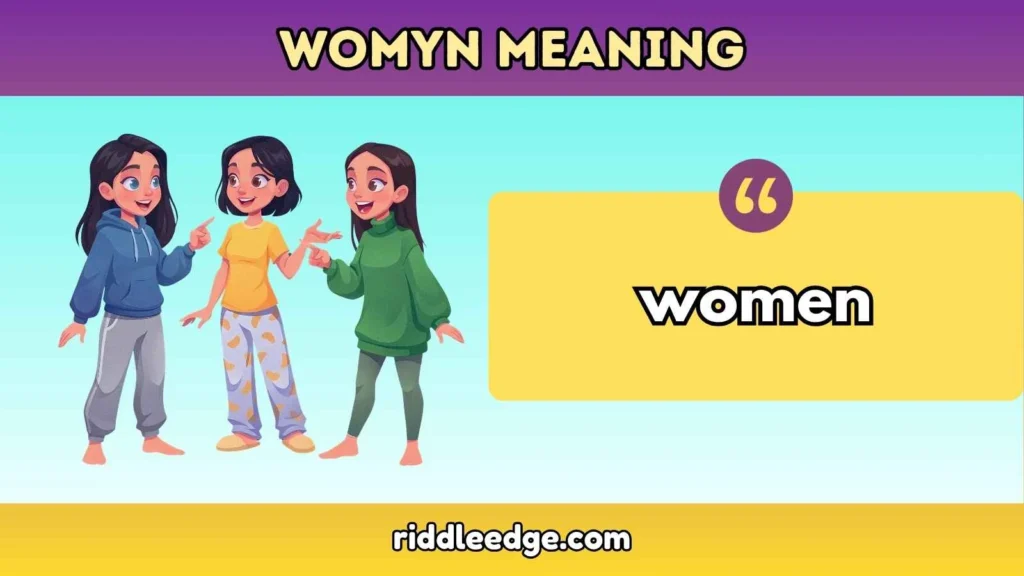
The term womyn is an alternative spelling of the word women. It is used primarily in certain feminist and social justice contexts to remove the word “men” from “women”, symbolizing independence from male-centered language.
In simple terms:
- Women → traditional spelling
- Womyn → intentional alternative spelling
The meaning of womyn goes beyond grammar. It reflects a philosophical and political stance about gender, identity, and language.
The Origin of the Word Womyn 🕰️
The word womyn emerged during the second-wave feminist movement in the 1970s. Feminists at the time questioned how deeply patriarchy was embedded in everyday language.
They noticed that:
- The word man often represented all humans
- The word woman visually and linguistically included man
To challenge this structure, activists introduced womyn as a way to emphasize that women exist independently, not as a derivative of men.
“Language is not neutral; it reflects power.”
Why Is “Womyn” Spelled Without “Men”? ✂️
At the heart of the womyn meaning is symbolism. Removing “men” from “women” was meant to:
- Reject male-centered linguistic norms
- Highlight women’s autonomy
- Challenge patriarchal traditions
This spelling was never about grammar rules. It was about making a statement ✊.
Womyn vs Women: Key Differences Explained 🔍
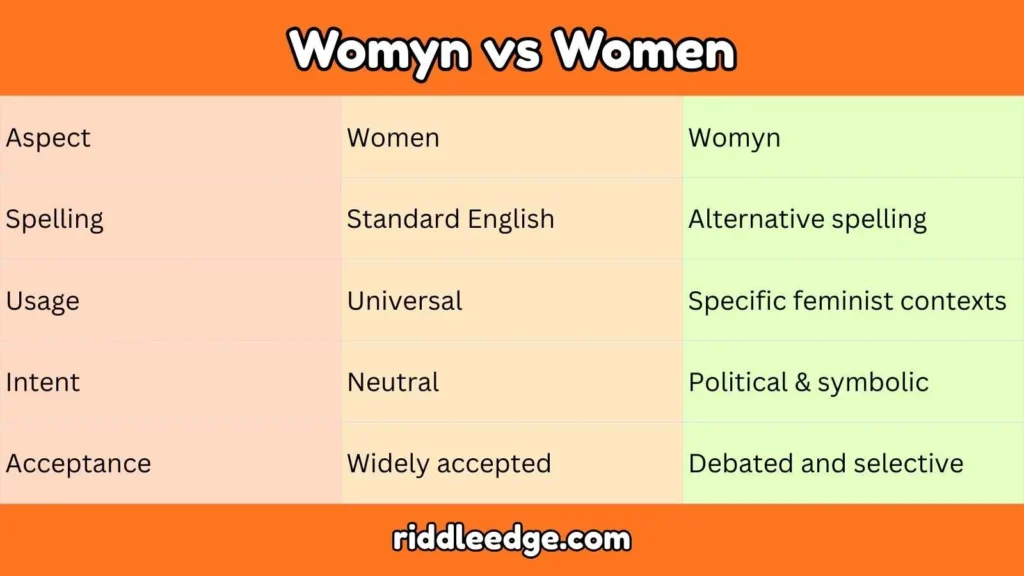
| Aspect | Women | Womyn |
|---|---|---|
| Spelling | Standard English | Alternative spelling |
| Usage | Universal | Specific feminist contexts |
| Intent | Neutral | Political & symbolic |
| Acceptance | Widely accepted | Debated and selective |
Both words refer to adult human females, but the intent and tone behind their use are different.
Is Womyn Still Used Today? 🧭
Yes — but selectively.
The use of womyn has declined in mainstream language, but it still appears in:
- Feminist literature 📚
- Academic discussions
- Activist spaces
- Art and cultural events
However, modern conversations about inclusivity have reshaped how people view the term.
Womyn and Gender Inclusivity 🌈
One important discussion around the womyn meaning is inclusivity.
Some critics argue that:
- The term may exclude transgender women
- It can feel biologically restrictive
As a result, many communities now prefer more inclusive terms like:
- Women
- Women and femmes
- All women
This shows how language evolves alongside social understanding 🧠.
Examples of Womyn Used in Sentences ✍️
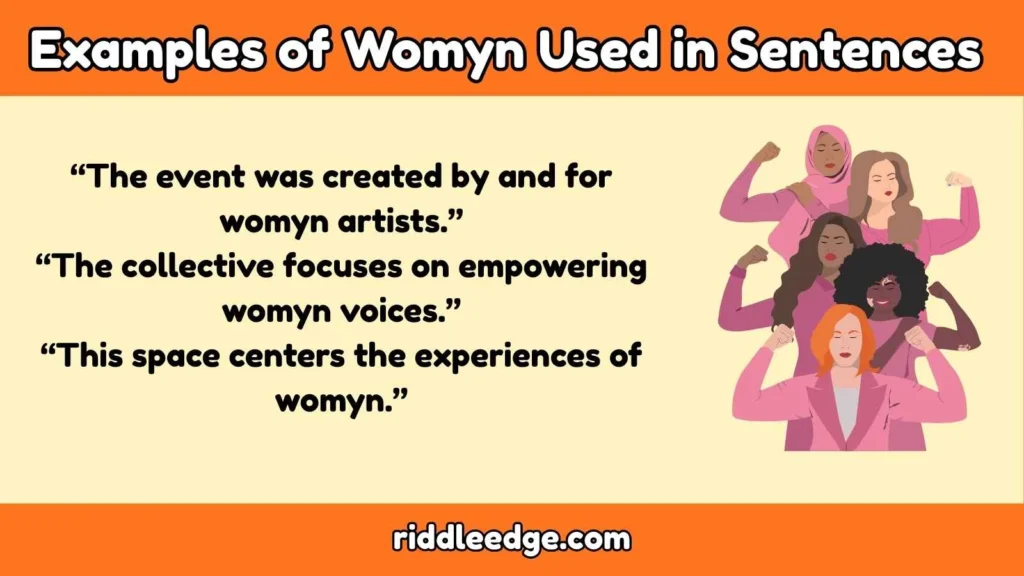
Here are a few contextual examples:
- “The event was created by and for womyn artists.”
- “The collective focuses on empowering womyn voices.”
- “This space centers the experiences of womyn.”
Notice how the word is often used in intentional, value-driven contexts.
Is Womyn a Dictionary Word? 📘
Yes, womyn appears in several modern dictionaries, usually labeled as:
- Alternative spelling
- Feminist usage
- Nonstandard English
This classification reflects its cultural relevance rather than everyday usage.
Common Misunderstandings About Womyn ❗
Let’s clear up some myths:
- Myth: It’s a typo ❌
Truth: It’s intentional ✅ - Myth: Everyone should use it ❌
Truth: It’s context-specific ✅ - Myth: It replaces “women” ❌
Truth: It coexists with it ✅
Why Language Choices Matter 🗣️
Words carry history, emotion, and power. Choosing to use or not use womyn is often about:
- Respect
- Identity
- Awareness
Understanding the womyn meaning helps us communicate more thoughtfully 💬.
Womyn in Pop Culture and Art 🎨

The term has appeared in:
- Poetry and spoken word
- Music and album titles
- Art exhibitions
Artists often use womyn to make a statement about empowerment and resistance.
Should You Use the Word Womyn? 🤷♀️
There’s no universal rule.
You might consider:
- The audience you’re addressing
- The space or community
- The values being expressed
When in doubt, clarity and respect should come first ❤️.
FAQs
What is the simple meaning of womyn?
Womyn is an alternative spelling of women, used mainly in feminist contexts to remove “men” from the word.
Is womyn offensive?
It depends on context. Some view it as empowering, while others see it as outdated or exclusionary.
Is womyn still relevant today?
Yes, but its usage is more limited and thoughtful compared to the past.
Can I use womyn in academic writing?
Only if it fits the subject matter and is clearly defined for readers.
What is the difference between womyn and women?
The difference lies in intention, not meaning. Both refer to adult human females.
Final Thoughts:
The word womyn is more than a spelling variation.
It represents a moment in history, a challenge to norms, and an ongoing conversation about language and identity.
By understanding the womyn meaning, we become more aware communicators and more thoughtful readers.
Language evolves — and so do we.

I love exploring the meaning behind words and ideas, turning simple thoughts into clear and engaging content. At Punswave, I focus on explaining meanings in an easy and interesting way for everyone.