Have you ever wondered what descendant truly means? Whether you’re exploring your family tree 🧬, reading literature, or just curious about genealogy, understanding this term can give you a deeper connection to your roots.
In this guide, we’ll dive into the definition, origin, examples, and practical usage of the word descendant. Let’s uncover the fascinating world of family lineage together! ✨
What Does “Descendant” Mean? 🤔
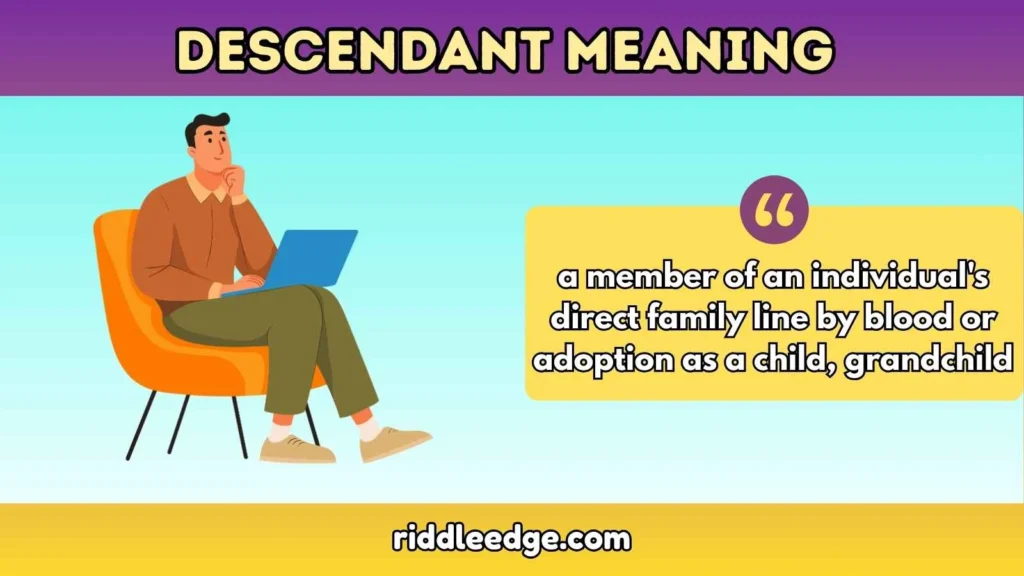
The term descendant refers to a person, animal, or plant that comes from a specific ancestor. Simply put, a descendant is someone or something that is the “offspring” of a previous generation. This could include children, grandchildren, great-grandchildren, and beyond.
- Human Context: A child or grandchild of a person.
- Biological Context: Any organism that comes from a previous generation.
- Cultural/Metaphorical Context: Ideas, traditions, or movements that evolve from earlier origins.
Quick Examples of Descendant
- John is a descendant of Queen Victoria 👑.
- The oak tree’s acorns produce descendants that grow into new trees 🌱.
- The Renaissance artists were descendants of classical Greek and Roman traditions 🎨.
Origin of the Word “Descendant” 📜
The word descendant comes from the Latin word descendere, meaning “to go down” or “to descend.” Over time, it evolved in Middle English to describe people who come down in lineage from an ancestor.
| Language | Word | Meaning |
|---|---|---|
| Latin | descendere | to go down |
| Middle English | descenden | to come from an ancestor |
| Modern English | descendant | offspring, heir, progeny |
Descendant vs. Ancestor: Understanding the Difference ⚖️
It’s easy to confuse descendants with ancestors, but the difference is simple:
- Ancestor: A person from whom you are descended (parents, grandparents, etc.) ⬆️
- Descendant: A person who comes from you or another ancestor ⬇️
Think of it like a family tree 🌳: ancestors are at the top, descendants are at the bottom.
Importance of Descendants in Genealogy 🔍
Genealogy is all about tracing your family lineage. Knowing who your descendants are is just as important as knowing your ancestors. Families often use this knowledge to:
- Preserve traditions and heritage 🏠
- Understand genetic traits and health risks 🧬
- Document family history for future generations 📖
Types of Descendants 🧩
Descendants can be categorized depending on how directly they come from an ancestor:
- Direct Descendant: Children, grandchildren, etc. – straight line of descent.
- Collateral Descendant: Nephews, nieces, cousins – descendants of a sibling of an ancestor.
- Lineal Descendant: Direct bloodline, commonly used in legal terms.
Descendants in Legal Context ⚖️
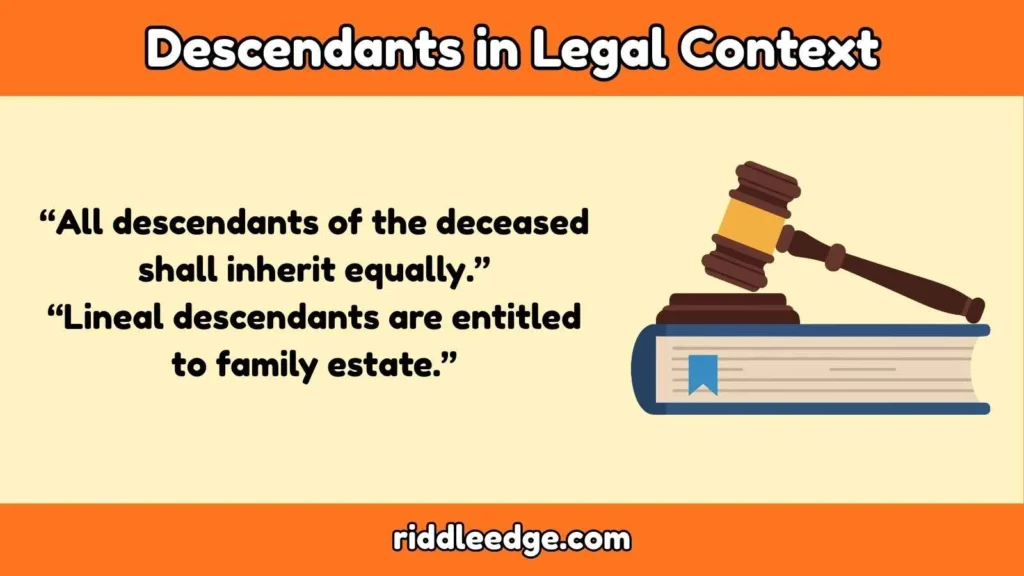
In law, descendant often refers to someone who inherits property, titles, or rights from their ancestors. Legal documents might specify:
- “All descendants of the deceased shall inherit equally.”
- “Lineal descendants are entitled to family estate.”
Descendant in Literature & Culture 📚
In stories, descendants often carry the legacy of their ancestors. This might appear in:
- Fantasy novels with royal bloodlines 👑
- Historical fiction tracing family legacies 🏰
- Folklore and myths, where traits or curses pass down generations 🧙♂️
How to Identify Your Descendants 🧬
Modern tools make tracking descendants easier than ever:
- Genealogy websites and DNA testing kits 🧪
- Historical birth, marriage, and death records 📜
- Family interviews and oral histories 🎤
Descendants in Biology & Evolution 🌱
In biology, descendants are essential for understanding evolution. Every living organism today is a descendant of previous species. For example:
- Birds are descendants of certain dinosaur species 🦖➡️🦜
- Modern humans are descendants of primates 🐒➡️🧑
Examples of Descendants in Everyday Life 🏡
- Your children are your direct descendants 👶
- Your pet’s offspring are their descendants 🐶
- Cultural practices that evolve over generations are metaphorical descendants 🎎
Common Misconceptions About Descendants ❌
- Descendants only refer to humans – False. Animals and plants also have descendants.
- Descendants always inherit wealth – False. Inheritance depends on legal rules.
- Descendants are always aware of their lineage – False. Some family lines are lost to history.
Descendant in Popular Expressions 💬
People sometimes use descendant metaphorically:
- “He is a descendant of innovation” – meaning ideas evolved from predecessors 💡
- “The town’s architecture is a descendant of colonial design” – influence over time 🏛️
Tables & Charts for Understanding Descendants 📊
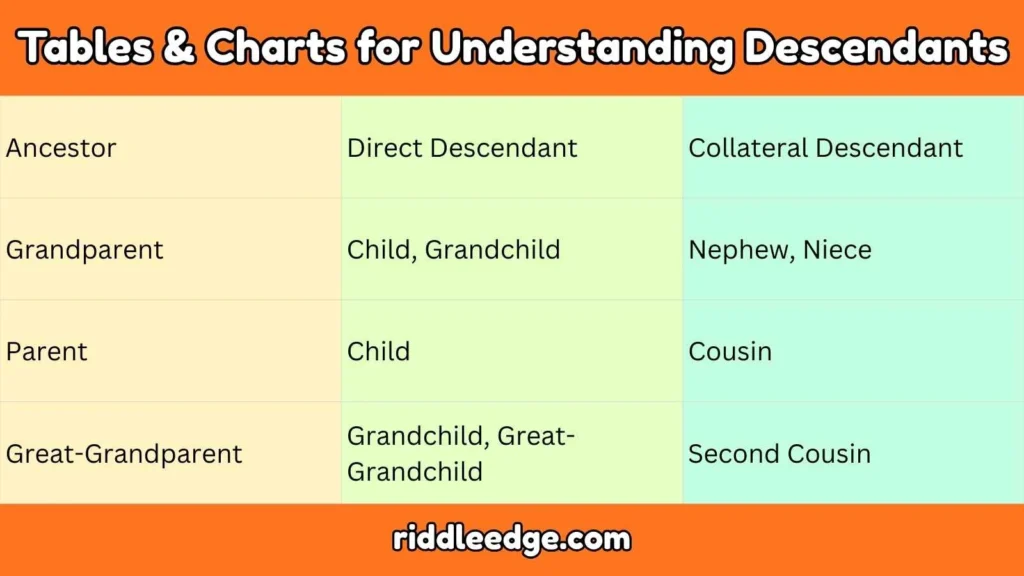
| Ancestor | Direct Descendant | Collateral Descendant |
|---|---|---|
| Grandparent | Child, Grandchild | Nephew, Niece |
| Parent | Child | Cousin |
| Great-Grandparent | Grandchild, Great-Grandchild | Second Cousin |
Why Understanding Descendants Matters 🌟
Recognizing descendants helps us:
- Appreciate our family heritage ❤️
- Preserve traditions and values 🏡
- Trace health patterns and ancestry 🧬
- Understand the ripple effect of our actions on future generations 🌊
FAQs
1. Are descendants only human?
No! Animals, plants, and even cultural ideas can be descendants of a previous generation.
2. Is a grandchild a descendant?
Yes, a grandchild is a direct descendant of their grandparents.
3. Can descendants inherit property?
Yes, but inheritance depends on legal rules, wills, or estate laws.
4. What is the opposite of a descendant?
The opposite is an ancestor – someone you come from, rather than who comes from you.
5. How can I find my descendants?
Use genealogy websites, DNA testing, and family records to trace your descendants accurately.
Conclusion:
Understanding the meaning of descendant gives us a window into the past and a roadmap to the future.
Whether in genealogy, biology, law, or culture, descendants connect us to our roots and legacy.
By learning about descendants, we celebrate our heritage, preserve our stories, and understand the ripple of life across generations. 🌳

I love exploring the meaning behind words and ideas, turning simple thoughts into clear and engaging content. At Punswave, I focus on explaining meanings in an easy and interesting way for everyone.