Ever received a message that simply says “FYI” and made you pause for a second? 🤔 You’re not alone. In today’s fast-paced digital world, short text abbreviations like this carry a lot of meaning in very few letters.
The FYI meaning in text is one of the most common yet misunderstood expressions in modern communication. Sometimes it feels helpful. Other times, it can sound cold or even passive-aggressive 😬. Context matters—and that’s exactly what this guide will help you understand.
In this complete, in-depth article, you’ll learn what FYI really means, where it came from, how it’s used in texting, work chats, emails, and social media, and how to avoid common mistakes. By the end, you’ll feel confident using FYI naturally and appropriately in any situation ✅.
What Does FYI Mean in Text? 📱
FYI stands for “For Your Information.” In text messages and online communication, it’s used to share information that the sender believes may be useful, relevant, or important for the receiver.
The core idea behind the FYI meaning in text is simple: “I’m telling you this so you’re aware.”
It does not usually require a response. Instead, it acts as a heads-up, update, or informational note 🧠.
FYI = “You don’t have to act on this, but you should know.”
The Origin of FYI: Where Did It Come From? 📜
The phrase For Your Information dates back to formal written communication long before texting existed. It was commonly used in:
- Business memos
- Office letters
- Military and government documents
As communication evolved, the phrase was shortened to FYI for efficiency. When email became popular, FYI quickly became a standard professional abbreviation. Later, it naturally transitioned into texting and instant messaging 💻➡️📱.
Despite its formal roots, FYI is now widely used in both casual and professional conversations.
FYI Meaning in Texting and Online Chats 💬
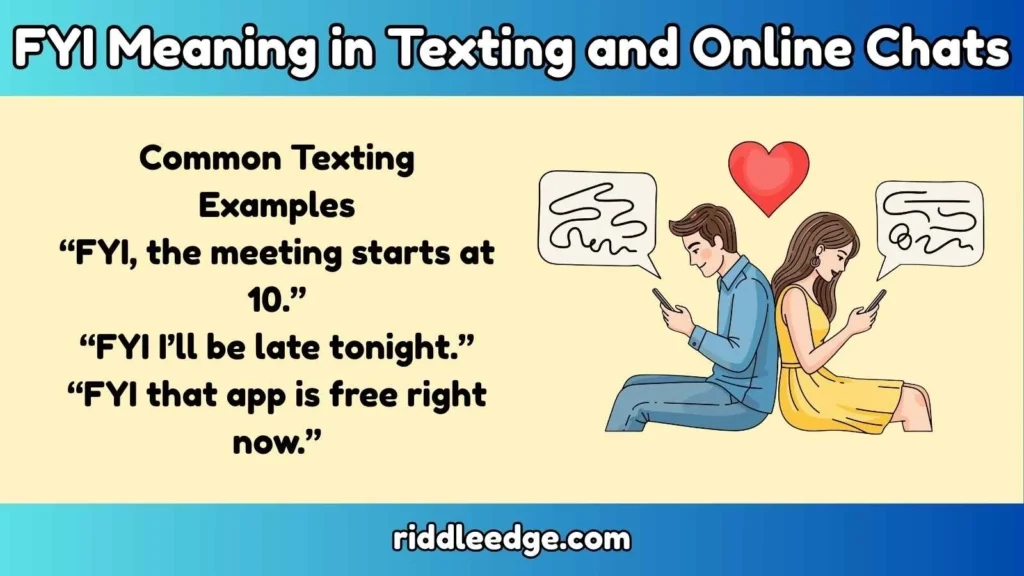
In everyday texting, FYI usually signals that the sender is sharing information without expecting action.
Common Texting Examples
- “FYI, the meeting starts at 10.”
- “FYI I’ll be late tonight.”
- “FYI that app is free right now.”
Here, FYI acts as a helpful heads-up. It’s neutral, informative, and efficient ⚡.
Is FYI Polite or Rude? Understanding the Tone 😐😠
This is where many people get confused. The FYI meaning in text can change depending on:
- Context
- Relationship between sender and receiver
- Sentence structure
- Punctuation and emojis
Neutral or Helpful Tone 😊
When used politely, FYI feels informative:
“FYI 😊 the store closes at 8.”
Cold or Passive-Aggressive Tone 😬
Without context, FYI can sound dismissive:
“FYI, that was already decided.”
Adding warmth, explanation, or an emoji can soften the tone and prevent misunderstandings.
FYI vs Similar Text Abbreviations 🔄
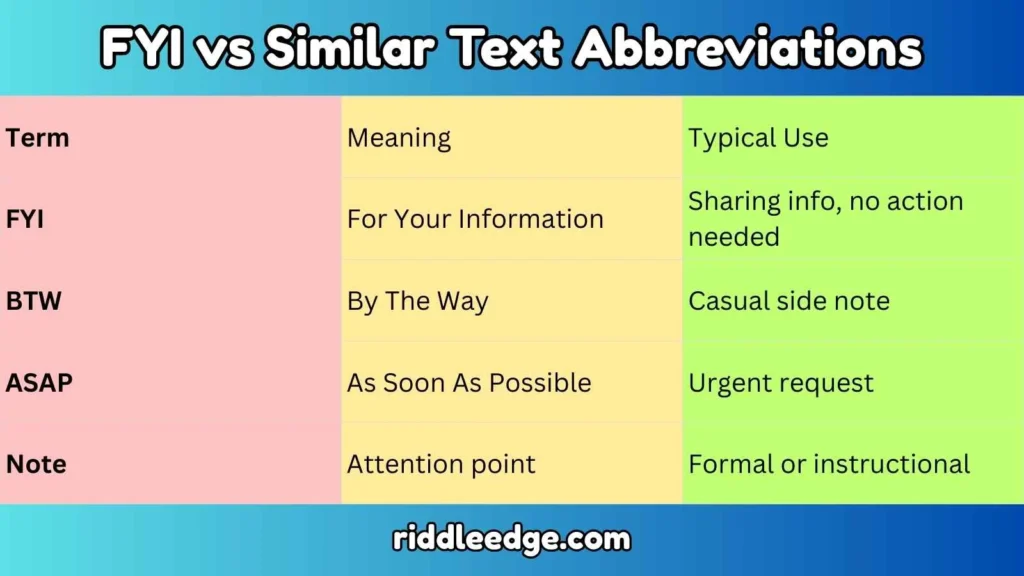
| Term | Meaning | Typical Use |
|---|---|---|
| FYI | For Your Information | Sharing info, no action needed |
| BTW | By The Way | Casual side note |
| ASAP | As Soon As Possible | Urgent request |
| Note | Attention point | Formal or instructional |
Unlike urgent abbreviations, FYI does not pressure the reader. It simply informs 🧩.
FYI Meaning in Work Texts and Professional Messages 💼
In professional environments, FYI is extremely common. It helps keep communication efficient and clear.
Professional Examples
- “FYI, the deadline has been extended.”
- “FYI I’ve shared the updated document.”
- “FYI, the client approved the proposal.”
In work settings, FYI often signals transparency and awareness rather than instruction.
However, overusing FYI without context can sound abrupt. Adding a short explanation improves clarity.
FYI Meaning on Social Media 🌐
On social platforms, FYI is often used to:
- Correct misinformation
- Share updates
- Add context to posts
Example:
“FYI, this video is from last year, not recent.”
Here, FYI acts as a factual clarification rather than an opinion.
How to Use FYI Correctly in a Sentence ✍️
Using FYI correctly is simple if you follow these rules:
- Place it at the beginning of the sentence
- Follow it with a comma
- Keep the message clear and brief
Correct: “FYI, the train is delayed.”
Incorrect: “FYI the train is delayed FYI.”
Capitalization is optional in casual texting, but FYI is usually written in uppercase for clarity.
Common Misunderstandings About FYI ❌
- FYI is not a command
- FYI does not mean urgency
- FYI is not always rude
Most negative reactions come from missing tone or lack of context. A few extra words can make a big difference.
Real-Life Contexts Where FYI Is Useful 🌍
- Letting someone know about schedule changes
- Sharing updates without interrupting
- Providing background information
- Avoiding repetitive explanations
FYI works best when the goal is awareness, not action.
FAQs
What is the FYI meaning in text?
FYI means For Your Information. It’s used to share helpful or relevant information without expecting a response.
Is FYI rude in texting?
Not inherently. It depends on tone, context, and wording. Adding friendliness helps avoid misunderstandings.
Should FYI be used in professional messages?
Yes. FYI is widely accepted in professional communication when used clearly and respectfully.
Do you need to reply to FYI?
Usually, no reply is required unless clarification or acknowledgment is necessary.
Can FYI be used casually?
Absolutely. FYI is common in casual texts, chats, and social media posts.
Final Thoughts:
The FYI meaning in text is all about awareness. It’s a small phrase with big impact—capable of being helpful, neutral, or misunderstood depending on how it’s used.
When used thoughtfully, FYI improves clarity, saves time, and keeps communication smooth. Add context, keep your tone friendly, and you’ll never go wrong 😊.
Language keeps evolving, but understanding these small details makes a big difference in how we connect every day.

I love exploring the meaning behind words and ideas, turning simple thoughts into clear and engaging content. At Punswave, I focus on explaining meanings in an easy and interesting way for everyone.