JW meaning in text is one of those abbreviations that often leaves people confused, curious, or even slightly embarrassed to ask about. You may have seen it pop up in a casual chat, a comment thread, or a quick DM and wondered, “Wait… what does JW mean here?” 🤔
You’re not alone. Modern digital conversations are filled with shorthand expressions designed to save time, add tone, and keep things informal. Some abbreviations are obvious, while others—like JW—depend heavily on context.
This in-depth guide will break down everything you need to know about the jw meaning in text, from its origins and common interpretations to real-life examples, correct usage, and potential misunderstandings. By the end, you’ll read messages with confidence and clarity. ✅
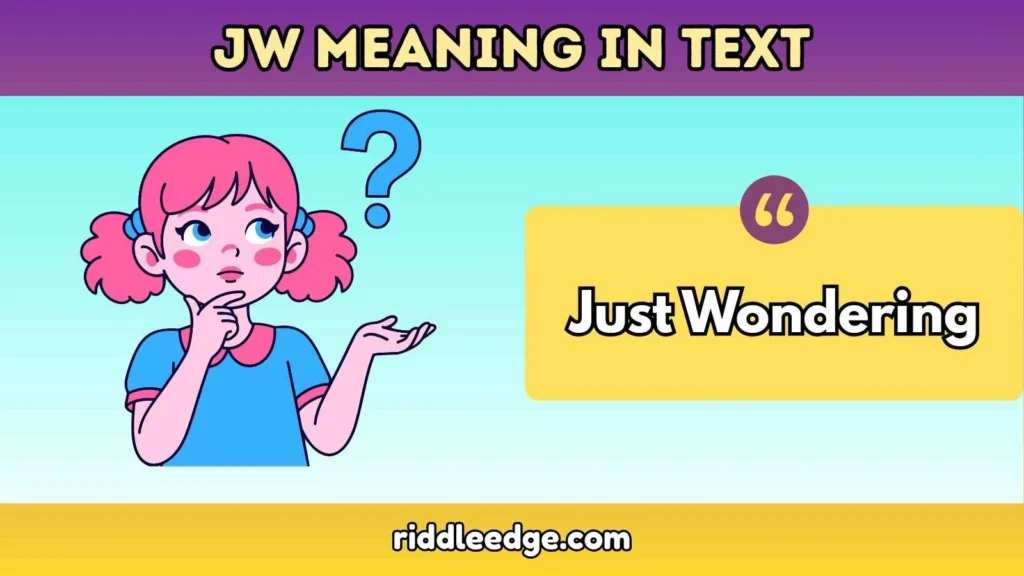
What Does JW Mean in Text? 🧐
In most texting and online messaging contexts, JW stands for:
“Just Wondering”
It’s a casual way to ask a question without sounding demanding or intrusive. When someone uses JW, they’re usually signaling curiosity rather than urgency.
“I’m not pushing for an answer—I’m just curious.”
This makes JW especially popular in friendly conversations, informal work chats, and social media interactions.
Why People Use JW in Text Messages 💬
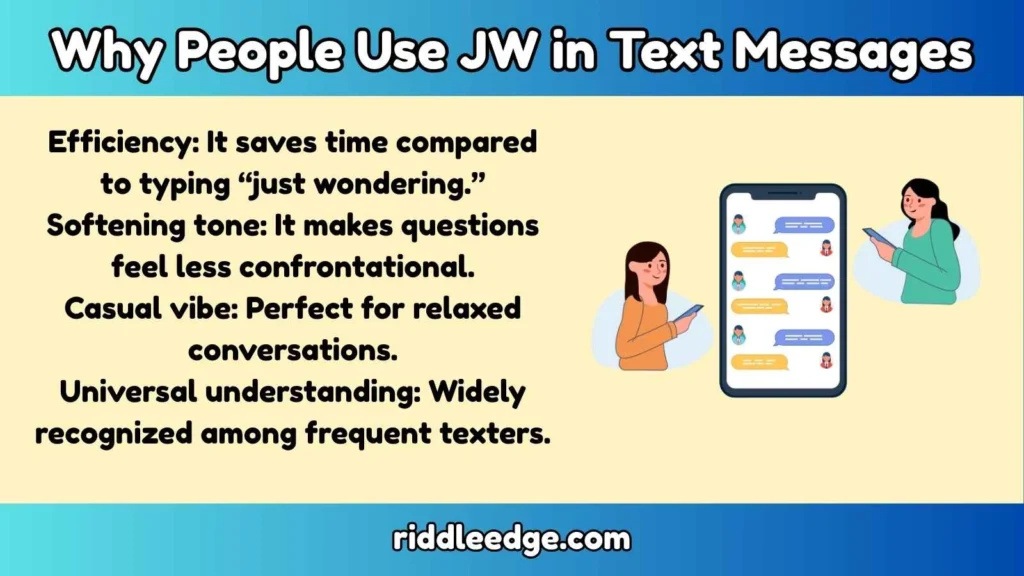
Language evolves with technology, and texting culture values speed and tone. Here’s why JW meaning in text has become so popular:
- Efficiency: It saves time compared to typing “just wondering.”
- Softening tone: It makes questions feel less confrontational.
- Casual vibe: Perfect for relaxed conversations.
- Universal understanding: Widely recognized among frequent texters.
In short, JW helps maintain a friendly, non-threatening tone in digital communication. 😊
The Origin of JW as Text Slang 📜
The abbreviation JW comes directly from the phrase “just wondering.” As texting and instant messaging became mainstream, people started shortening commonly used phrases.
Unlike slang rooted in subcultures, JW evolved naturally from everyday English. Its simplicity helped it spread quickly across platforms like SMS, chat apps, forums, and social media.
Because it’s intuitive, many users understand it instantly—even if they’ve never consciously learned it.
Common Contexts Where JW Is Used 🧠
Understanding jw meaning in text requires context. Here are the most common situations where you’ll see it:
1. Friendly Conversations
Used when asking something casual without pressure.
2. Workplace Messaging
Often appears in informal team chats to sound polite.
3. Social Media Comments
Helps avoid sounding judgmental or aggressive.
4. Relationship Chats
Used to ask sensitive questions gently.
Examples of JW in Text Messages ✉️
Examples make everything clearer. Here’s how JW appears in real conversations:
- “JW, are you free later tonight?”
- “I saw your post—JW what inspired it?”
- “JW if the meeting is still on?”
- “Not trying to rush you, JW 😊”
Notice how JW softens the message and reduces pressure.
JW vs Other Similar Text Abbreviations 🔍
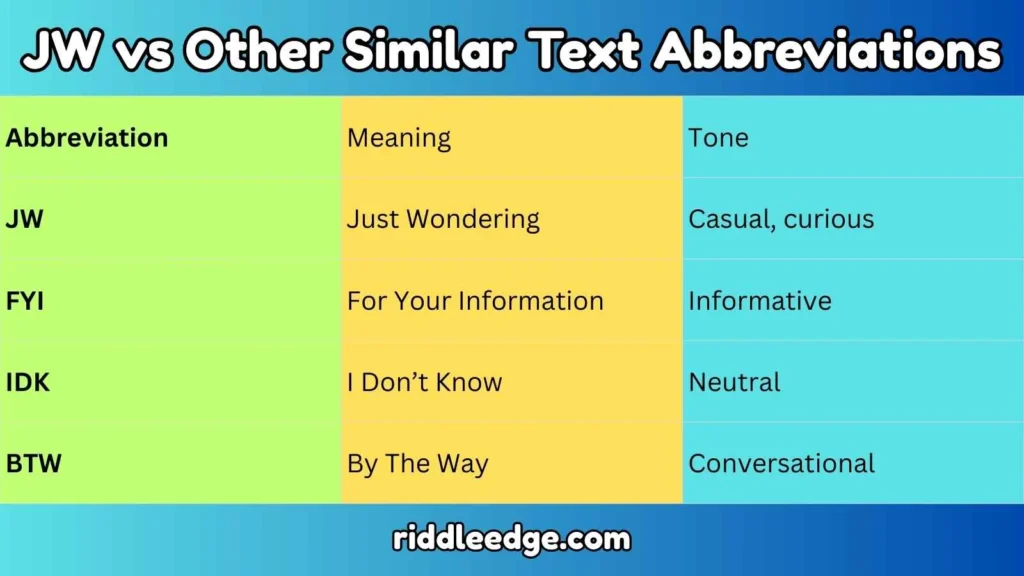
| Abbreviation | Meaning | Tone |
|---|---|---|
| JW | Just Wondering | Casual, curious |
| FYI | For Your Information | Informative |
| IDK | I Don’t Know | Neutral |
| BTW | By The Way | Conversational |
JW stands out because it expresses curiosity rather than information or opinion.
Is JW Ever Misunderstood? ⚠️
Yes, occasionally. While JW meaning in text is usually “just wondering,” it can be confused with other meanings in non-text contexts.
For example:
- Religious discussions (where JW may refer to something else)
- Initials or usernames
- Professional abbreviations
In texting, however, JW almost always means “just wondering.” Context clears confusion quickly.
How Tone Changes with JW 😊
One of the biggest benefits of using JW is tone control. Compare these two messages:
Without JW: “Why didn’t you reply?”
With JW: “JW why you didn’t reply 🙂”
The second feels less accusatory and more understanding. That’s the power of JW meaning in text.
Should You Use JW in Professional Settings? 💼
It depends on the environment.
- Casual teams: Yes, it’s often acceptable.
- Formal emails: Better to write it out fully.
- Internal chats: Common and friendly.
If in doubt, spell out “just wondering” for clarity.
JW in Social Media and Online Communities 🌐
On social platforms, JW is frequently used to ask questions without sounding confrontational.
Example:
“JW, what made you choose that approach?”
This phrasing invites conversation rather than debate.
How to Reply When Someone Uses JW 🤝
If someone uses JW in a message to you, there’s no need to overthink it.
- Respond honestly
- Match their casual tone
- Clarify if needed
They’re simply expressing curiosity.
Is JW Still Relevant in 2026? 📆
Absolutely. Despite evolving slang, jw meaning in text remains relevant because:
- It’s easy to understand
- It feels natural
- It fits modern communication styles
Simple abbreviations often last the longest.
FAQs
What does JW mean in texting?
It usually means “just wondering.”
Is JW rude?
No. It’s generally polite and casual.
Can JW have multiple meanings?
In texting, it almost always means “just wondering.” Context matters.
Is JW used by all age groups?
Yes. It’s common among teens, adults, and professionals.
Should I avoid using JW?
Only in very formal writing. Otherwise, it’s perfectly fine.
Final Thoughts:
JW meaning in text is simple, friendly, and incredibly useful. It stands for “just wondering” and helps people ask questions without pressure or judgment.
As digital communication continues to grow, understanding abbreviations like JW ensures clearer, kinder conversations. Whether you’re texting a friend, replying to a coworker, or engaging online, this small abbreviation can make a big difference. 😊
Keep exploring, keep learning, and stay fluent in modern digital language.

I love exploring the meaning behind words and ideas, turning simple thoughts into clear and engaging content. At Punswave, I focus on explaining meanings in an easy and interesting way for everyone.